




![IM608 PRO II Full Kit<br>[2-Year Free Update]](http://www.obdprice.com/cdn/shop/files/Autel_IM608S_II_Full_Kit_1_600x600.webp?v=1755662636)

![IM508S PRO<br>[2-Year Free Update]](http://www.obdprice.com/cdn/shop/files/Autel_MaxiIM_IM508S_Pro_600x600.webp?v=1755662755)
![IM508S<br>[2-Year Free Update]](http://www.obdprice.com/cdn/shop/files/AUTEL_MAXIIM_IM508S_600x600.webp?v=1755662895)










When vehicles experience abnormal idling, increased fuel consumption, or an illuminated engine malfunction light, many car owners hear the same advice: reset the ECM. But can the engine control module truly be reset at home? What are the specific steps? Are there any risks involved?
This article systematically explains the ECM's function, when it needs resetting, the specific procedure, and post-reset precautions to help you complete the operation safely.

What is the Engine Control Module (ECM)?
The Engine Control Module (ECM), sometimes referred to as the ECU (Engine Control Unit), is the core control unit of modern automotive electronic systems.
Its primary responsibilities include:
- Controlling fuel injection volume
- Adjusting ignition timing
- Managing air-fuel ratio
- Regulating emissions system operation
- Coordinating idle speed and power output
Simply put, the ECM continuously collects sensor data (e.g., oxygen sensors, throttle position sensors, coolant temperature sensors) to dynamically adjust engine performance, ensuring a balance between power, fuel efficiency, and emissions. When internal ECM data becomes abnormal or learning values deviate, the vehicle may exhibit various performance issues.

Engine Control Module
When Might an ECM Reset Be Necessary?
Regular ECM resets are unnecessary; this procedure is only recommended under specific circumstances, such as:
1. Engine runs rough
- Idle fluctuates wildly
- Starts with jerks
- Occasional stalling while driving
These issues are sometimes linked to anomalies in the ECM's stored self-learning data.
2. Abnormally increased fuel consumption
If fuel consumption rises significantly after ruling out mechanical faults, it may indicate ECM deviation in fuel injection control.
3. Frequent dashboard warning lights
When the Check Engine Light illuminates, it is recommended to first use professional diagnostic equipment to read fault codes.
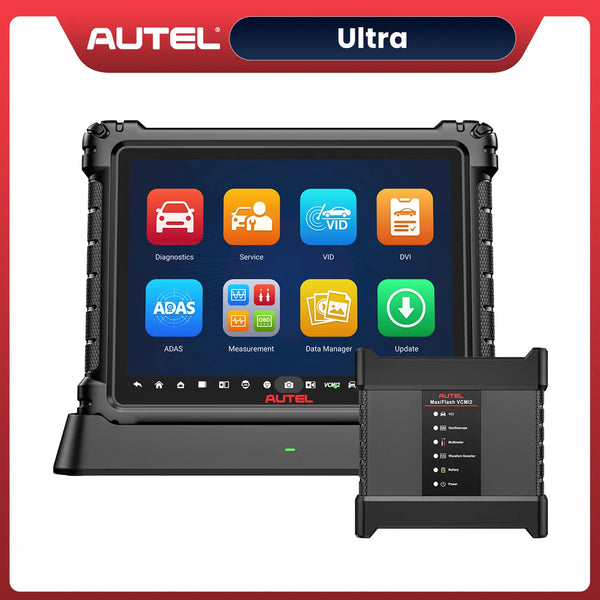
We recommend using professional diagnostic tools like the Autel MaxiCOM series scanner or Autel MaxiSys series devices. These can quickly read and clear fault codes while viewing real-time data streams to determine if ECM reset is necessary—rather than blindly disconnecting power.

Check Engine Ligt Illuminates
Preparations Before Resetting the ECM at Home
Before proceeding, ensure the following:
1. Ensure Safety
- Turn off the engine and removethe key
- Engage the parking brake
- Wear insulated gloves
2. Prepare Necessary Tools
- Wrench (typically used to disconnect the battery negative terminal)
- Digital multimeter (optional, for detecting residual voltage)
- OBD2 diagnostic scanner (Autel scanners recommended)
Common Methods for ECM Reset
Method One: Battery Disconnection Reset (Basic Approach)
This is the most common home reset method.
Step One: Disconnect the Negative Battery Terminal
Use a wrench to loosen the negative battery terminal and remove the negative cable.
⚠️ Disconnecting the negative terminal first prevents short-circuit risks.
Step 2: Discharge Residual System Current
After disconnecting the battery, press and hold the vehicle horn for approximately 30 seconds to help discharge residual capacitor energy.
Step 3: Wait for Reset Completion
Wait at least 15 minutes to ensure the ECM's internal cache data is fully cleared.
Step 4: Reconnect the Battery
Reinstall and tighten the negative terminal.

Reconect the Car's Battery
Step 5: Start Engine and Perform Idle Learning
Start the engine and let the vehicle idle for approximately 10 minutes.
During this phase, the ECM will relearn engine operating parameters.
Method 2: Reset Using an OBD Scanner (Recommended for Professionals)
Using a scanner is safer and more precise than the power-off method.
Using an Autel OBD2 scanner enables:
- Clear fault codes
- Reset adaptive values
- Perform throttle mapping
- Reset idle learning
Advantages include:
- Does not affect other vehicle electronic systems
- Preserves personalized settings like audio and anti-theft features
- Better suited for newer vehicles with complex electronics
For vehicles equipped with smart keys, electronic parking brakes, or automatic start-stop systems, diagnostic equipment is strongly recommended over simple power disconnection.
What checks should be performed after reset?
1. Road test verification
Conduct a 10–20 minute road test to observe:
- Smoothness of acceleration
- Stability of idle speed
- Return to normal fuel consumption

Road test to check driving conditions
2. Inspect the dashboard
If warning lights reappear, the issue likely stems from:
- Sensor malfunction
- Ignition system problems
- Emission system abnormalities
In such cases, use an Autel scanner, such as Autel MK808BT Pro, to read fault codes for further diagnosis.
FAQs About ECM Resets
Q1: Does the ECM require periodic resets?
No. Resets are only necessary when replacing components (e.g., throttle body, oxygen sensor) or when specific faults occur.
Q2: Can resetting the ECM improve fuel efficiency?
Improvement may occur if fuel consumption issues stem from erroneous self-learning data. However, it will not resolve mechanical failures.
Q3: Will powering down affect other vehicle settings?
The following may be cleared:
- Radio presets
- Clock time
- Power window learning values
- Newer models may experience greater impact.
Q4: Is it safe to perform this at home?
Risks are low when following proper procedures. However, for hybrids or high-end vehicles, professional technicians are recommended.
Important Reminders
- Arbitrary power cycling may void warranties for vehicles still under coverage.
- Some high-end models require specialized equipment for ECM initialization and matching.
- Avoid frequent resets if the root cause remains unclear.
Conclusion
Resetting the engine control module is not a universal solution, but it can restore normal vehicle operation under specific circumstances.
For basic models, disconnecting the battery suffices for a simple reset; for modern vehicles with complex electronic systems, using an Autel professional diagnostic scanner ensures greater safety and precision.
If the issue persists after resetting, seek professional diagnosis promptly to avoid delaying repairs.


