





![IM608 PRO II Full Kit<br>[2-Year Free Update]](http://www.obdprice.com/cdn/shop/files/Autel_IM608S_II_Full_Kit_1_600x600.webp?v=1755662636)

![IM508S PRO<br>[2-Year Free Update]](http://www.obdprice.com/cdn/shop/files/Autel_MaxiIM_IM508S_Pro_600x600.webp?v=1755662755)
![IM508S<br>[2-Year Free Update]](http://www.obdprice.com/cdn/shop/files/AUTEL_MAXIIM_IM508S_600x600.webp?v=1755662895)











This technical guide provides a systematic, data-driven approach to diagnosing common air intake and fuel trim faults (DTCs P0102, P0113, P1101, P0174, and P2172) using Autel diagnostic scanners.
Covers intake airflow metering, air temperature sensing, lean mixture detection, and electronic throttle safety protection mechanisms.
Utilizes Live Data PID graphing, Freeze Frame analysis, MAF tap testing, and bi-directional active actuator tests.
High fuel trims (+20%+) at idle that normalize at 2500 RPM indicate a downstream vacuum leak rather than a faulty MAF sensor.
Ensures precise repair verification through Autel special functions, including Fuel Trim Reset and Throttle Body Idle Air Relearn.
Introduction to Modern Engine Air Management
Modern internal combustion engines rely on extreme precision in fuel metering to maintain the stochiometric air-fuel ratio of 14.7:1 (for gasoline engines). Achieving optimal combustion efficiency, low tailpipe emissions, and responsive throttle power requires the Powertrain Control Module (PCM) to constantly monitor incoming air volume, air temperature, intake manifold pressure, and electronic throttle position.
When an abnormality occurs in the air intake delivery or measuring apparatus—such as a dirty Mass Air Flow (MAF) sensor, a damaged intake boot, or a sticking electronic throttle body—the PCM registers Diagnostic Trouble Codes (DTCs). Unaddressed intake air issues often cascade into severe driveability symptoms, including engine hesitation, surge, hard starting, misfires, or limp-home mode.
Leveraging an advanced diagnostic scanner like the Autel MaxiSYS (MS906Pro, MS908S, Ultra) or Autel MaxiCOM (MK808S, MK906BT) enables technicians to move beyond simple code reading. By analyzing Live Data PID parameters, capturing Freeze Frame snapshots, and conducting Active Bi-Directional Component Tests, technicians can pinpoint the root cause in minutes rather than swapping expensive parts blindly.

Overview of Diagnostic Trouble Codes
This technical guide focuses on five interconnected air intake and fuel trim DTCs commonly encountered in daily garage diagnostics:
| DTC Description | Primary Component | Involved | Common Symptoms |
|---|---|---|---|
| P0102 | Mass or Volume Air Flow (MAF) Circuit Low Input |
MAF Sensor / Wiring Harness |
Stalling, hesitation, poor acceleration, dark exhaust |
| P0113 | Intake Air Temperature (IAT) Sensor 1 Circuit High Input |
IAT Sensor / Open Signal Wire |
Hard start cold/hot, rich fuel condition, poor mpg |
| P1101 | MAF Sensor Out of Self-Test Range / Performance |
MAF Sensor, PCV Valve, Intake Vacuum Leak |
Rough idle, check engine light, erratic shift points |
| P0174 | System Too Lean (Bank 2) | Vacuum Leaks, Gaskets, Dirty MAF, Fuel Injectors |
Engine misfire, lean surge, high Long Term Fuel Trim |
| P2172 | Throttle Actuator Control System - Sudden High Airflow Detected |
Throttle Body, Split Intake Boot, MAP Sensor |
Limp mode (reduced engine power), high idle, throttle hold |
Deep-Dive Analysis and Diagnostic Steps
Code P0102 – Mass Air Flow (MAF) Circuit Low Input
Technical Context: The MAF sensor measures the mass of air entering the engine by heating a small wire or film element. As air passes over the element, it cools down, requiring more electrical current to maintain a constant temperature. Code P0102 sets when the PCM detects that the MAF signal voltage drops below a calibrated lower threshold (typically below 0.2V or less than 1.0 g/s at key-on engine running) for a specified duration.
Autel Diagnostic Workflow:
- Read Freeze Frame Data: Connect your Autel scanner and access Diagnosis > Auto Scan > PCM > Freeze Frame. Check engine RPM, engine load, and vehicle speed at the moment P0102 was flagged.
- Analyze Live Data PID: Navigate to Live Data and select MAF (g/s) or MAF (V). At warm idle (700–800 RPM), a typical 2.0L to 3.5L engine should display between 2.0 g/s and 5.0 g/s. If the scanner reads 0.0 g/s or 0.0V, an electrical open or sensor failure exists.
- Circuit Testing: Inspect the MAF sensor connector. Use a digital multimeter or Autel MaxiIM/MaxiSYS built-in oscilloscope to verify 12V power supply, chassis ground, 5V reference (if applicable), and signal continuity back to the PCM.
While monitoring MAF (g/s) on your Autel screen in real-time graph mode, gently tap the body of the MAF sensor with the handle of a screwdriver. If the signal graph spikes violently or drops to zero, internal wire bonding inside the sensor housing has fractured, requiring sensor replacement.
Code P0113 – Intake Air Temperature (IAT) Sensor Circuit High Input
Technical Context: The IAT sensor is a Negative Temperature Coefficient (NTC) thermistor whose resistance decreases as air temperature rises. The PCM applies a 5V reference signal to the sensor. High signal voltage (approaching 5.0V) indicates high resistance, which the PCM interprets as extremely cold air temperature (e.g., -40°C / -40°F). Code P0113 usually signifies an open circuit in the IAT sensor or signal wiring.
Autel Diagnostic Workflow:
- Live Data Check: On your Autel scan tool, pull up the IAT (°C / °F) parameter. If it displays an unrealistic reading like -40°C (-40°F) while ambient shop temperature is 22°C (72°F), the circuit is completely open.
- Jumper Wire Test: Disconnect the IAT/MAF connector (IAT is often integrated into the 5-pin or 6-pin MAF assembly). Use a fused jumper wire to bridge the IAT signal pin and ground pin at the harness side. Observe the Autel screen: if the IAT temperature jumps to maximum (e.g., 120°C / 248°F) and sets a P0112 (Circuit Low), the wiring and PCM are intact, confirming a dead IAT sensor.
Code P1101 – MAF Sensor Out of Self-Test Range / Performance
Technical Context: Unlike P0102 (circuit fault), P1101 is a functional/performance code common on GM, Ford, and European vehicles. During key-on self-test or idle operation, the PCM compares actual MAF voltage against calculated air flow derived from Manifold Absolute Pressure (MAP), Throttle Position (TP), and engine speed. If the discrepancy exceeds 15–20%, P1101 is triggered.
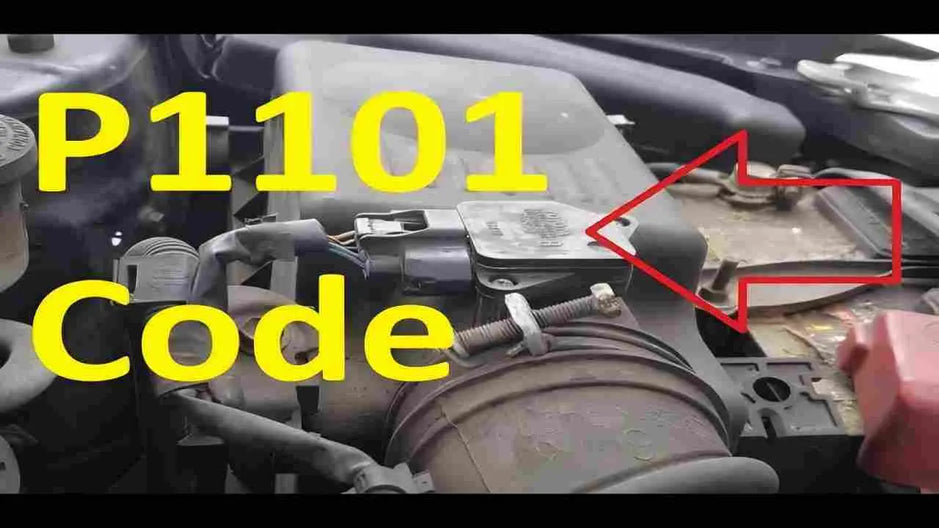
P1101 Code
Root Causes & Solutions:
- Contaminated MAF Hot Wire: Oil vapor from aftermarket oiled air filters or PCV blow-by coats the sensing wire, insulating it and causing delayed voltage response. Fix: Clean with dedicated MAF cleaner spray (never brake cleaner).
- Vacuum Leaks / PCV Stuck Open: Air entering behind the MAF sensor causes the MAF reading to underreport actual engine airflow.
- Autel Diagnostic Action: Graph MAF (g/s) alongside MAP (kPa) and Absolute Throttle Position (%) on your Autel tablet. Snap the throttle quickly to 3000 RPM. A healthy MAF sensor should react instantaneously without lag or flat spots in the curve.
Code P0174 – System Too Lean (Bank 2)
Technical Context: Code P0174 indicates that the PCM has added maximum allowable fuel compensation (Short Term + Long Term Fuel Trim typically exceeding +20% to +25%) to Bank 2 (the cylinder bank without cylinder #1) to maintain proper air-fuel balance.
If you see P0171 (Bank 1 Lean) and P0174 (Bank 2 Lean) together, suspect a central airflow metering issue (MAF, main intake tube leak). If only P0174 is present, focus on Bank 2 specific components: intake manifold gasket leaks on Bank 2 side, cracked exhaust manifold prior to O2 sensor, or clogged Bank 2 fuel injectors.
Fuel Trim Analysis with Autel:
- Select STFT Bank 2 and LTFT Bank 2 on your Autel screen. Note the total fuel correction at idle (e.g., LTFT +22%, STFT +5% = +27% total).
-
Increase Engine Speed to 2500 RPM:
- If fuel trims drop back to normal (+3% to +6%) at higher RPM, the root cause is a vacuum leak (unmetered air gets diluted by higher throttle volume).
- If fuel trims remain high or worsen at 2500 RPM under load, the root cause is a fuel delivery issue (weak fuel pump, clogged filter, clogged injectors) or a heavily skewed MAF sensor.
Code P2172 – Throttle Actuator Control (TAC) System - Sudden High Airflow Detected
Technical Context: P2172 is a critical safety code. Modern vehicles use Drive-by-Wire Electronic Throttle Control (ETC). The PCM monitors actual airflow against commanded throttle blade angle. If an abrupt, unmetered rush of air occurs without a corresponding accelerator pedal request, the PCM enters a "Reduced Engine Power" or "Limp Mode" state to prevent runaway acceleration.

P2172 Code
Diagnostic Steps using Autel Active Testing:
- Physical Inspection: Inspect the rubber intake boot between the MAF sensor and throttle body for severe cracks, disconnects, or loose hose clamps. Check for a stuck open PCV valve or blown intake manifold gasket.
- Throttle Body Carbon Inspection: Excessive carbon buildup around the throttle plate can disrupt air velocity at idle or cause the electronic motor to stick open under vacuum.
- Autel Bi-Directional Control & Adaptation: Navigate to Active Test > Throttle Actuator Control Test. Exercise the throttle blade while observing Throttle Position Sensor 1 & 2 Voltages. After cleaning a dirty throttle body, perform the Throttle Body Idle Air Volume Learn / Relearn procedure under Special Functions using your Autel tool to reset learned offset values.
Autel Live Data Parameter Quick Reference
When diagnosing air intake and fuel trim faults, compare your Autel scan tool's live parameter readings against these baseline values for a fully warmed-up gasoline engine at sea level idle:
| PID / Parameter | Normal Range at Idle | Fault Indication | Associated DTCs |
|---|---|---|---|
| MAF Air Flow | 2.0 – 5.0 g/s (Engine size dependent) | < 0.5 g/s or flatline zero | P0102, P1101 |
| IAT Sensor Temp | Ambient temp + 10–20°C | -40°C (-40°F) open circuit | P0113 |
| STFT + LTFT (Total) | -5% to +8% | > +15% to +25% (Lean) | P0174 |
| MAP Sensor | 28 – 35 kPa (8–10 inHg) | > 50 kPa at idle (Vacuum leak) | P1101, P2172 |
| Throttle Position (TP) | 2% – 12% (Key On, Engine Off) | Erratic spikes or slow response | P2172 |
Systematic Master Troubleshooting Procedure
To ensure accurate, efficient repair without unnecessary component replacements, follow this 5-step diagnostic protocol using your Autel scanner:
Step 1: Complete System Auto Scan & Freeze Frame Capture
Perform an all-system scan. Save the pre-repair diagnostic report to the Autel Cloud / internal memory. Examine Freeze Frame records to note engine speed, load, coolant temperature, and fuel trim status when the fault triggered.
Step 2: Visual & Physical Inspection
Inspect air filter housing, intake ducting, vacuum lines, PCV hoses, and electrical connectors. Check sensor wiring for chafing, terminal corrosion, or loose locking tabs.
Step 3: Live Data & Graphing Analysis
Boot up multi-PID graphing on your Autel tablet. Overlay MAF (g/s), Engine RPM, STFT Bank 2, and LTFT Bank 2. Perform a dynamic road test or snap throttle test to verify sensor responsiveness.
Step 4: Smoke Test & Active Diagnostics
If lean codes or high airflow codes (P0174, P2172) are active, introduce smoke into the intake plenum using an EVAP/Intake smoke machine to spot invisible vacuum leaks. Use Autel Active Tests to actuate throttle actuators, purge valves, and idle control systems.

Autel Scanners Active Tests Function
Step 5: Repair Verification & Special Function Reset
After repairing the fault (e.g., replacing MAF sensor, fixing vacuum leak, cleaning throttle body), clear all DTCs. Perform required adaptation routines (e.g., Fuel Trim Reset or Throttle Position Relearn) under Autel Special Functions. Conduct a complete OBD-II Drive Cycle to verify all readiness monitors clear successfully.
Conclusion
Air intake and fuel trim faults represented by codes P0102 , P0113 , P1101 , P0174 , and P2172 are intrinsically connected. A malfunction in signal output or physical airflow measurement at the front of the intake duct creates downstream fuel metering errors and driveability degradation.
By integrating the advanced capabilities of Autel Scanners—such as real-time multi-graphing, bi-directional testing, freeze frame analysis, and special relearn functions—technicians can systematically isolate electrical harness flaws from vacuum leaks and mechanical component failures. This data-driven diagnostic approach ensures accurate first-time repairs, reduces shop teardown time, and maximizes customer trust.


